

Written by the Artspire Home design team. Australian-owned modern furniture studio, showroom at 335 St Kilda Road, St Kilda VIC 3182, open 7 days. 5-year structural warranty on every piece. Free metropolitan Melbourne delivery. Last updated May 2026.
An honest comparison for Australian homes. Marble, travertine, or sintered stone — what you actually want depends on your floor, your household, and how much weekend you want to spend on stone sealer. This guide walks through the trade-offs with real Australian prices, real durability data, and specific recommendations from our St Kilda Road showroom.
TL;DR — Which One Should You Buy?
| Choose Marble if you want… | Choose Travertine if you want… | Choose Sintered Stone if you want… |
|---|---|---|
| Dramatic veining as a focal point | Warm, organic texture that recedes | Marble or travertine looks with no sealing |
| A formal, polished feel | A relaxed, lived-in aesthetic | A clean, modern minimalist look |
| Don't mind annual sealing | Are okay with sealing every 12 months | Kids, pets, hot pans, red wine — zero stress |
| Apartment with concrete floor | Heritage home with timber subfloor | Any home — lightest of the three |
| Artspire range: $359 – $1,399 | Artspire range: $454 – $1,329 | Artspire range: $378 – $2,520 |
Quick answer · Should I buy marble, travertine, or sintered stone?
Choose natural marble for unique veining and a formal aesthetic; expect to seal annually and treat with care. Choose natural travertine for warm, organic texture in casual or Mediterranean-styled rooms. Choose sintered stone if the look matters but daily life — kids, pets, red wine, hot pans — should not destroy it. Sintered stone is 2-3× harder than either natural option, requires no sealing, and dominates the Artspire range because it solves the practical problem most Australian homes care about.
Buying with confidence. Every stone table at Artspire ships with a 5-year structural warranty and the option to view marble, travertine, and sintered stone side-by-side under the same lighting at our 335 St Kilda Road showroom in Melbourne — open 7 days. Free metropolitan Melbourne delivery; Australia-wide flat-rate shipping. Customisation available with an 8-week production cycle.
What Each Stone Actually Is
Three materials, three different origins.
Marble is metamorphic limestone — compressed and recrystallised under heat and pressure over millions of years. The dramatic veining is mineral impurity that did not fully homogenise. Carrara, Calacatta, and Statuario all come from the Apuan Alps in Italy. Most marble sold in Australia today is Vietnamese, Turkish, or Greek — still real marble, just less dramatic veining at roughly a quarter of the Italian price.
Travertine is a freshwater limestone, formed where mineral-rich hot springs evaporated over centuries. The small holes you can see and feel are gas pockets from formation. Most slabs are filled and polished. The Romans lined their bath houses and the Colosseum in it. Almost all travertine in Australia today is imported from Turkey or Iran — so when a sales person tells you "premium Italian travertine," it is marketing copy. There is no premium Italian travertine in commercial quantities.
Sintered stone is the modern alternative. Engineered from compressed natural minerals (feldspar, silica, mineral oxides) fused under extreme heat and pressure into a single dense slab, sintered stone can be made to mimic marble veining, travertine warmth, or pure neutrals. It sits at 7-8 on the Mohs hardness scale versus 3-4 for natural stone — meaning it scratches less, etches less, and stains effectively never. The trade-off is consistency: the veining repeats across the slab, missing the unique-piece feel of quarried material.
Artspire stocks all three in tables. Most flagship pieces (Plinth, Crescendo, Stoneleaf) are sintered. Wave Coffee Table and Marble Pedestal Table are natural marble. The Plinth Travertine pieces are real natural travertine bonded to aluminium honeycomb panels for lighter weight.
Hardness and Daily Durability
Natural marble and travertine both sit at 3-4 on the Mohs hardness scale. For context: a steel knife is 5.5, your fingernail is 2.5, granite is 6-7. So both natural stones are softer than the everyday objects that find their way onto a coffee table.
Marble shows scratches mercilessly. A wine glass scraped across a polished white marble surface leaves a fine etch you can see. It will not crack, but the high-gloss finish that makes marble look luxurious is also what makes every micro-scratch visible.
Travertine hides daily wear. The natural texture and matte finish camouflage the kind of microscopic scratches that ruin marble. A scratch on travertine usually disappears into the existing texture. Spills are less visible against the cream-and-walnut tonal variation.
Both stones etch when they meet anything acidic — lemon juice, red wine, vinegar, tomato sauce. On marble, the dull spot stands out against the polish. On travertine, you usually do not see it.
Sintered stone is in a different category. At 7-8 on Mohs, it resists scratches from cutlery, etching from spills, and heat marks from hot pans. It is non-porous, so it does not require sealing. The Plinth Demeter we sell sees showroom traffic six days a week and still looks new — that is the durability advantage in practice.
Quick answer · Which scratches more easily — marble or travertine?
Travertine hides scratches noticeably better than marble. Both rate 3-4 on the Mohs hardness scale, so both will scratch from steel cutlery — but travertine's matte texture camouflages micro-scratches that remain plainly visible on polished marble. Sintered stone (7-8 on Mohs) outperforms both. For households with kids or pets, sintered stone is the most forgiving by a wide margin; travertine is the most forgiving of the natural options.
Weight — The Question Nobody Asks Until They Buy One
This is where most online guides fall short.
A solid travertine coffee table top, 120 × 70 × 4 cm thick, weighs 70-90 kg. The same dimensions in solid marble: 95-115 kg. Travertine has gas pockets, so it weighs roughly 30% less than marble per cubic centimetre.
Sintered stone tables vary dramatically by construction. Solid sintered slabs are denser than marble, but most Australian retailers (including Artspire) use sintered stone on internal support structures — wooden frames in our Plinth Demeter, aluminium honeycomb in our Stone Coffee Table, steel skeletons in our dining range. This brings the weight down to a delivery-friendly 13-50 kg for most coffee tables and 50-70 kg for dining tables. Compare against the 100 kg of our solid Wave Coffee Table (natural marble + tinted glass) — that is the practical weight gap.
In practical terms for Australian homes:
- Apartment / strata building: any material works on concrete floors. Lift dimensions are usually the limit; everything in our range disassembles for delivery through standard apartment lifts.
- Heritage Victorian or Federation home with timber subfloors on 600 mm joists: prefer sintered stone or hollow-cored travertine. The 50+ kg saved matters when load concentrates in four legs.
- Two-person delivery is mandatory for any stone piece above 40 kg. Artspire includes this as standard for Melbourne metro; interstate buyers should confirm with the carrier.
- Removalist cost on a future move: solid stone tables often need their own quote. Some removalists refuse them outright. Worth knowing before you buy if you might relocate.
Quick answer · How heavy is a typical stone coffee table?
Solid travertine 120 × 70 × 4 cm: 70-90 kg. Solid marble same dimensions: 95-115 kg. Most Australian retailers (including Artspire) build sintered stone on internal frames — 13-50 kg for coffee tables, 50-70 kg for dining. The lightest pieces in the Artspire range are 13 kg (Stone Coffee Table — Plinth Travertine, cube). The heaviest is the Wave Coffee Table at 100 kg (solid natural marble + glass).
Aesthetics — How Each Reads in a Real Room
Marble shouts. Travertine whispers. Sintered stone behaves.
Marble wants to be the focal point. A polished Calacatta-style coffee table in a neutral lounge pulls the eye every time. The veining acts almost like abstract art on a horizontal canvas. Great if your room is otherwise quiet — soft fabrics, neutral walls, simple silhouettes. Overwhelming if your room is already busy.
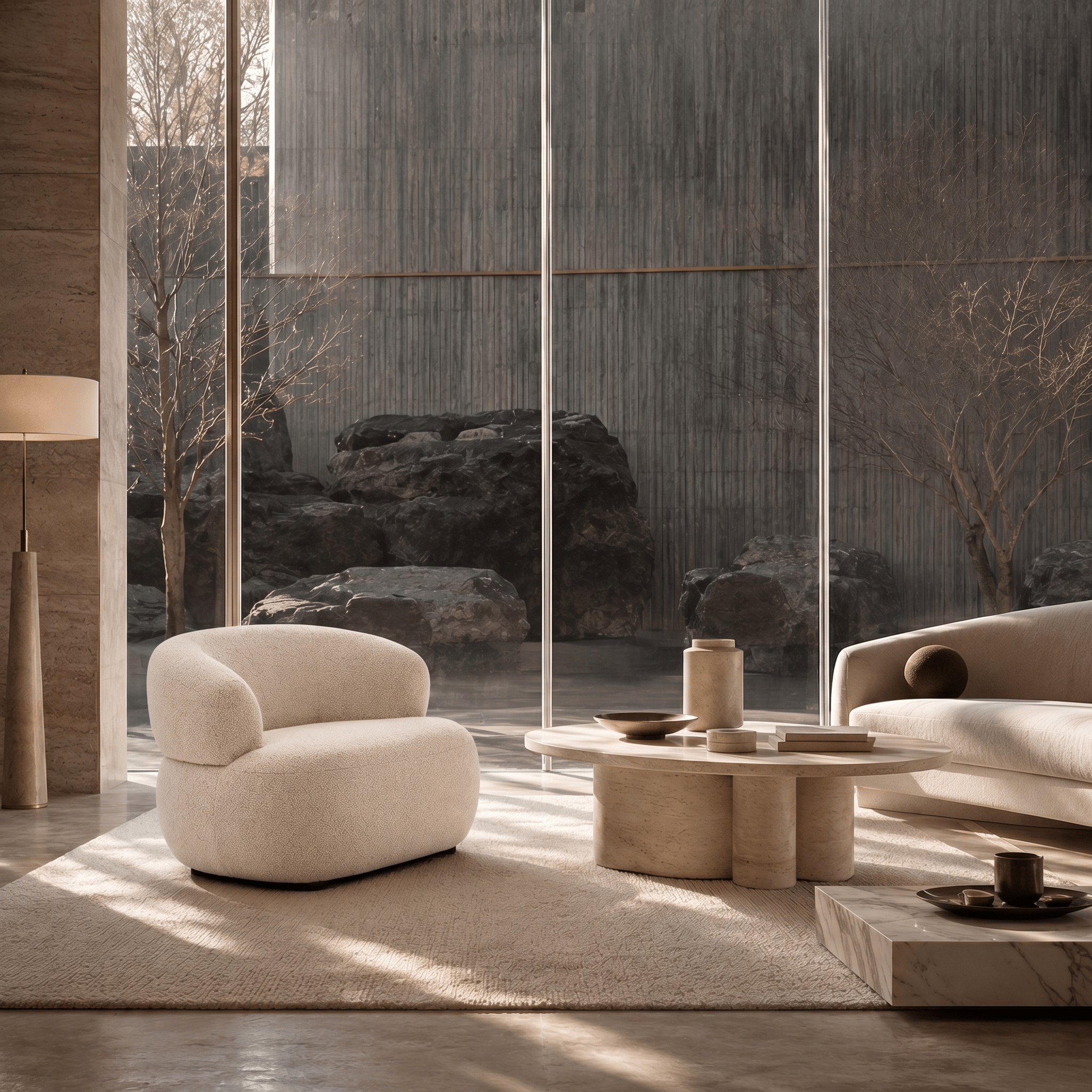
Travertine recedes. The horizontal striations and matte finish work as a quiet anchor, especially in rooms with strong textiles (boucle, linen, jute) or warm timbers (oak, walnut). Australian interiors that lean into Mediterranean, wabi-sabi, or modern coastal — travertine is almost the default coffee table.
Sintered stone is neutral by design. It can copy marble drama or travertine warmth; what it brings is consistency. The veining repeats across the slab, missing the unique character of natural stone but reading as cleanly modern. This is why sintered stone dominates premium Australian retailers in 2026 — minimalist and Japandi interiors prefer the surface uniformity, and parents prefer the durability.
Cost in Australia — Real Prices, Real Ranges
These are Artspire's current retail prices (in AUD, May 2026). Pricing includes the typical Australian markup for delivered furniture; bare slab prices from a stone yard are lower but you need a workshop to make a table.
| Piece | Material | Artspire Price | RRP |
|---|---|---|---|
| Pic Ivoire Side Table | Natural marble + brass | $359 | $513 |
| Marble Pedestal Table | Natural marble + bronze steel | from $378 | $648 |
| Round Plinth Travertine Coffee Table | Natural travertine | $454 | $649 |
| Plinth Demeter Coffee Table | Sintered stone + wooden frame | from $454 | $649 |
| Stone Coffee Table — Plinth Travertine | Natural travertine + aluminium honeycomb | from $664 | $799 |
| Modern Curve Coffee Table | Sintered stone + carbon steel | $699 | $1,000 |
| Crescendo Marble Dining Table | Sintered stone + aluminium | from $1,049 | $1,499 |
| Twin Peaks Coffee Table | Sintered stone + carbon steel | from $1,175 | $1,960 |
| Wave Coffee Table | Natural marble + tinted glass | $1,399 | $1,999 |
| Stoneleaf Dining Table | Sintered stone + multilayer timber | from $2,341 | $3,345 |
What this pricing tells you. Natural marble side tables and pedestals start at $359 because they use small pieces of marble. Larger marble coffee tables jump fast — the Wave at $1,399 is solid slab with glass insert. Natural travertine sits in the $454-$1,329 range; aluminium honeycomb backing lets us hit lower price points. Sintered stone is the widest range ($378-$2,520) because it can be built as small as a side table or as large as an 180 cm dining table without weight or cost penalties.
Quick answer · What is the cheapest stone coffee table option in Australia?
Natural marble side tables start lowest ($359 at Artspire for the Pic Ivoire), but they're side-table format only. For full-size stone coffee tables in Australia, sintered stone wins on price-to-value — Artspire's Plinth Demeter starts at $454, and the Modern Curve Coffee Table is $699. Natural travertine sits at $454-$1,329. Solid natural marble coffee tables are the premium tier at $1,399+.
Real Australian Considerations
This is the section the imported buyer guides skip.
Heat in Australian summers. A polished marble surface in direct northern sunlight feels cold to touch but reaches 40 °C+ over a long January afternoon. Travertine's lighter colour and matte finish heats less aggressively. Sintered stone handles heat the best — both ambient sun and hot serving dishes leave no marks. None of the three will warp or crack from heat, but if your sofa setup places the coffee table in afternoon sun, factor in surface temperature for the people using it.
Hard water in Sydney, Adelaide, and Perth. Hard water leaves mineral deposits when it dries on stone. Wipe spills immediately on natural stone — especially marble, where the mark will be visible against the polish. Sintered stone is non-porous and indifferent to water hardness.
Termite-prone regions. Stone tables with timber bases (common in Australian designs — oak, walnut, teak under stone) need the same termite considerations as the rest of your timber furniture. Solid stone or sintered-stone-on-aluminium-honeycomb construction sidesteps the issue.
Rental properties. Stone tables are heavy. Some Australian removalists refuse stone outright; others charge double. If you rent and might relocate, ask before you buy. Sintered stone on honeycomb backing is the most rental-friendly of the three.
Five-year reality check. All three materials look better at 5 years than at 5 days, if cared for. Travertine develops a patina; marble veining seems to deepen as micro-etches catch the light differently; sintered stone looks identical to day one because nothing has happened to it. None of these "wear out" in any practical sense.
Best Choice For… Pair the Material to Your Life
A decision shortcut based on what we see in the showroom most weekends.
| If you are… | Best material | Specific Artspire pick |
|---|---|---|
| Family with kids under 10 | Sintered stone | Plinth Demeter · from $454 |
| Apartment renter | Sintered or honeycomb travertine | Plinth Travertine Coffee Table · from $664 |
| Heritage Victorian homeowner | Sintered stone | Modern Curve Coffee Table · $699 |
| Design-led couple, no kids | Natural marble | Wave Coffee Table · $1,399 |
| Mediterranean / wabi-sabi interior | Natural travertine | Round Plinth Travertine · $454 |
| Modern minimalist interior | Sintered stone | Twin Peaks Coffee Table · from $1,175 |
| Entertainer who hosts often | Sintered stone (dining) | Crescendo Marble Dining · from $1,049 |
| Pet owner with claws on the floor | Sintered stone | Celian Coffee Table Set · from $378 |
Decision feels close? Three ways forward.
→ Browse online: all stone tables at artspirehome.com.au/collections/modern-coffee-table or dining at /collections/modern-dining-table.
→ Visit the showroom: 335 St Kilda Road, St Kilda. Open 7 days. See marble, travertine, and sintered stone under identical lighting. No appointment needed.
→ Talk to our design team: free 30-minute consult by phone, video, or in-person. Call 0433 626 428 or email info@artspirehome.com. We will help you match material, dimension, and silhouette to your specific room.
A Closer Look at Sintered Stone — Why It Dominates Premium Australian Retailers in 2026
Walk into any premium Australian furniture showroom in 2026 and "marble" or "travertine" on the showroom card often does not mean the natural quarried stone described above. Most flagship tables are sintered stone with a marble-look or travertine-look surface.
Sintered stone is made from compressed natural minerals (feldspar, silica, mineral oxides) fused at extreme heat and pressure into a single dense material. Mohs 7-8 versus 3-4 for natural stone. Non-porous; no sealing required. Resists scratches from cutlery, etching from acidic spills, and heat marks from hot pans.
The aesthetic trade-off: veining is consistent across the slab, missing the "every piece is unique" feel of quarried material. Some buyers want exactly that consistency (modernist / minimalist interiors); others want the lottery of natural variation (collectors / heritage interiors).
How to tell sintered from natural at a glance. Look at the edge of the slab — natural stone shows mineral variation right through the cut; sintered stone looks identical surface and edge because the slab is engineered as one consistent piece. Weight is another tell: solid sintered slabs are 10-15% denser than natural marble at the same thickness, but most sintered tables are built on honeycomb or steel frames to manage shipping weight, so they end up lighter.
Frequently Asked Questions
Is sintered stone the same as quartz or porcelain?
No. All three are engineered surfaces, but sintered stone (Dekton, Lapitec, Neolith are the original brands) uses minerals only — no resin binder. Quartz uses 90-95% ground quartz with polymer resin. Porcelain is fired clay. Sintered stone is the hardest of the three and the only one rated for both indoor and outdoor use.
Is marble or travertine better for a household with young children?
Of the natural stones, travertine. The matte finish hides the scratches and ring marks that come with toys, snack plates, and a four-year-old's "art project." But if you have the option, sintered stone is best — it shrugs off the daily damage that natural stone slowly accumulates. Marble in a chaotic household is asking for a lot of patience.
Will a sintered stone table feel cheap compared to natural marble?
No, but it will feel different. Quality sintered stone reads as "considered, modern, intentional." Quality natural marble reads as "luxurious, formal, statement." Both can be expensive; both can be design-led. The choice is aesthetic, not economic. Side-by-side at the Artspire showroom under the same lighting, most visitors cannot tell which is which on first glance.
Can I leave a hot mug on these tables?
On sintered stone, yes. On natural marble and travertine, use a coaster — hot drinks will not damage the stone, but they can leave water rings that need attention before they set, and acidic spills can etch.
How often do I need to seal a natural stone table?
Seal when new, then every 12 months for travertine and every 18-24 months for marble. A bottle of impregnating stone sealer costs around $40 and takes 20 minutes to apply. Sintered stone does not require sealing — ever.
Are filled travertine tables better than unfilled?
For a coffee table or dining table, filled is more practical — fewer crumb traps, easier to wipe down. Unfilled travertine looks more authentic and works well for decorative pieces (vases, plinths), but high-traffic surfaces benefit from filling.
Does the colour fade in Australian sun?
No. Stone colour comes from mineral content; UV does not bleach it. The sealer may break down faster in direct sun, so you will re-seal slightly more often on a sun-exposed natural stone piece.
How do I tell sintered stone from natural marble or travertine at the showroom?
Look at the edge — natural stone shows mineral variation right through the cut; sintered stone is uniform from face to edge. Weight is another tell: solid sintered slabs are denser than natural marble at the same thickness, but most retail tables are built on internal frames so the final weight depends on construction. The product spec sheet should state material outright; if it does not, ask before purchasing.
Browse the Artspire Stone Collection
Below is a snapshot of the current Artspire stone range. Every piece ships with a 5-year structural warranty and free Melbourne metro delivery.
Coffee tables (10 pieces in stock or available)
· Celian Coffee Table Set — from $378 (was $810). Sintered stone top, saddle leather, nylon rope, pine wood draw.
· Plinth Demeter Coffee Table — from $454 (was $649). Sintered stone over hardwood frame. Showroom hero.
· Round Plinth Travertine Coffee Table — $454 (was $649). Natural travertine.
· Stone Coffee Table — Plinth Travertine — from $664 (was $799). Natural travertine on aluminium honeycomb.
· Modern Curve Coffee Table — $699 (was $1,000). Sintered stone, carbon steel base.
· Twin Peaks Coffee Table — from $1,175 (was $1,960). Sintered stone on brushed carbon steel.
· Wave Coffee Table — $1,399 (was $1,999). White natural marble with grey tinted glass.
Dining tables (6 pieces)
· Crescendo Marble Dining Table — from $1,049 (was $1,499). Sintered stone marble look + aluminium legs.
· Hourglass Dining Table — $1,134 (was $1,620). Sintered stone, carbon steel frame.
· Croxx Dining Table — from $1,399 (was $1,999). Sintered stone, steel legs, 160 cm.
· Zuri Dining Table — $1,417 (was $2,025). Sintered stone, aluminium, 130 cm round.
· Marianna Dining Table — $1,959 (was $2,799). Sintered stone, aluminium, 119.5 cm round.
· Stoneleaf Dining Table — from $2,341 (was $3,345). Sintered stone, multilayer timber, 180 cm.
Side & bar tables
· Pic Ivoire Side Table — $359 (was $513). Natural marble + bronze steel.
· Marble Pedestal Table — from $378 (was $648). Natural marble desktop, antique bronze stainless steel column.
· Halo Tall Bar Table — $662 (was $945). Sintered stone, carbon steel.
· Luna Curved Bedside Cabinet — $435 (was $621). Sintered stone, faux leather, MDF.
Visit our showroom at 335 St Kilda Road, St Kilda to compare marble, travertine, and sintered stone side-by-side under the same lighting — the easiest way to decide which suits your home.
Why buy from Artspire.
- 5-year structural warranty on every stone piece.
- Free metropolitan Melbourne delivery; Australia-wide flat-rate shipping.
- Australian-owned, Melbourne showroom open 7 days at 335 St Kilda Road, St Kilda.
- Customisation available — fabric, dimensions, configuration on selected ranges (8-week production).
- Showroom design consults are free and without commitment.
About the Artspire Home design team
Artspire Home is a Melbourne-based modern furniture studio established in 2022. Our in-house team includes architects, interior designers, landscape architects, and graphic designers. We import, source, and customise furniture for Australian homes from our showroom at 335 St Kilda Road, St Kilda, with delivery Australia-wide. This guide reflects our combined experience selling and styling stone tables across Melbourne, Sydney, and Brisbane.
artspirehome.com.au · info@artspirehome.com · 0433 626 428 · 335 St Kilda Road, St Kilda VIC 3182
Last updated: May 2026. © Artspire Home. Material recommendations reflect Artspire's showroom experience and industry-standard data. Prices are current at time of publication and may change. Promotional pricing applies to current stock; older pricing shown for comparison.